Monday, 2 February 2015

Assignment 4 planning (part 7) - first draft...

First cut document submitted to my tutor for feedback:

Objectivity, ethics and understanding…
Introduction

Lyrics from Lilly Allen’s song ‘The Fear[1]


I don't know what's right and what's real anymore
And I don't know how I'm meant to feel anymore
When do you think it will all become clear?

I'll look at The Sun and I'll look in The Mirror
I'm on the right track; yeah, I'm on to a winner

Allen’s song went straight to number 1 in January 2009 and whilst it was doubtless written ‘tongue-in-cheek’, it nonetheless, packs a weighty punch directly at the culture we have created. Allen’s keen observational skills enable her to poke fun at everybody, including herself, at the same time as abdicating any responsibility for the situation – “And it's not my fault; it's how I'm programmed to function.”

In our celebrity-obsessed, media-focused culture, it’s hardly surprising the Allen’s words “I don't know what's right and what's real anymore” ring with an ironic truth. As photographers, are we not at least partially complicit in creating this kind of confusion between what’s right and what’s real?

Photography has never been, is not and never will be ‘objective’. Is it not time we stopped talking about photographic objectivity and started talking about the subjective truth of photographs?

Objectivity
“For the first time, an image of the world is formed automatically, without the creative intervention of man… [requiring only] …the instrumentality of a non-living agent.[2]” “The status of photography, at its birth, hinged on what was thought to be its capacity for objective transcription[3]” and for decades subsequent literature about photography repeated this “litany of photographic truth[4]” until it became a universal myth. “The photograph may distort; but there is always a presumption that something exists, or did exist, which is like the photograph[5]” and this is fundamentally why the photograph has been unable to shake off this myth.

Objectivity is by definition “activities (including behaviours) not influenced by personal feelings or opinions in considering and representing facts”. Objectivity relating to photography falls into two main categories:
Category 1.   The scene – the objective recording, by the camera and the photographer, of what was actually in front of the camera.
Category 2.   The photograph – the duty of the photographic team – photographer, developer, editor – the objective presentation of what was captured in camera.

Category 1 – the scene
“The human eye takes its visible world with it as it walks[6]”, in other words we are able to see everything but not all at once - our eye flits form one part of a scene to the other; the camera on the other hand, sees every detail all at once but only within its specific frame of reference – the boundary of the photograph. Thus the camera has not only changed the way we see, it has given us more to see and because of this new level of detail changed the way in which we perceived things.

To understand how photographs work subjectively we must accept the photographic paradox[7], that in addition to photographic composition (the denotation), the photographic sub-text (the connotation) of the image plays an integral part and must also be considered. These two different but important messages do not work in ‘collusion’; rather, they form a structural paradox, wherein the connotation is developed from information from the denotation. This ‘development’ in turn creates an ethical paradox; theoretically the denoted information is ‘neutral and objective and copies reality meticulously’, only to be ‘challenged’ by the coded message (the connotation) that requires interpretation by the viewer resulting in a potentially dramatically skewed reading because of their knowledge, understanding and cultural biases.

Connotation is further skewed when the photographer elects to stage the physical objects within the frame. Isobel Hilton (The Guardian) echoes this view, in her article entitled ‘The Camera Never Lies[8]” (2008), on the run up to the Robert Capa-retrospective at the Barbican in 2008, re-reviewing the controversy surrounding Capa’s photograph of Federico Borrell GarcĂ­a (1936) and commented on war photography that “Ever since cameras first went to war, photographers have staged scenes, rearranged bodies and had events re-enacted for the camera and we look at them in two states of mind - open to their impact as authentic images, and aware that to perceive the camera as a neutral observer is naive.

Ethics
Category 2 – the photograph
William Mitchell, accepted the existence of fake images and commented that “extreme manipulation … [was] … technically difficult, time-consuming and outside the mainstream of photographic practice.[9]” However, by the early 1900’s photographers were ‘normally’ reworking their negatives to create the ‘perfect’ image. Ansel Adams (who died in 1984) revisited favourite sites and reworked his negatives (from that site) until he was happy with the results, of ‘Moonrise’ (Hernandez, New Mexico, 1941) he stated that “the negative was always difficult to print” – requiring significant dodging and burning to create an acceptable print – he continued “it is safe to say, that no two prints are precisely the same.[10]

Reuter’s[11] stance on manipulation is “that anything that could have been done in a dark room is acceptable, but we can't tolerate anything that changes the editorial context”. To put this into context “Reuters, is one of the world’s largest international multimedia news providers, reaching more than one billion people every day.[12]”Thus, clearly the manipulation carried by Adams was acceptable; unfortunately when Paul Hanson carried out the same techniques on his winning World Press Photo (in 2012) of Muhammad and Suhaib Hijazi, the very emotional debate that followed conceded that it ‘did not change editorial context’ but left world opinion divided regarding the need for that ‘type’ of manipulation.

Approve or otherwise, the situation remains that photographers regularly used dark room tools to perfect the look of their images. Historically, the tonal look of an image started with the film the photographer preferred, this was further enhanced by the chemical ‘reworking’ and lead to the development of individual styles; similarly today many documentary photographers have developed very unique and recognisable styles enabling them to stand out in the crowd, for example, Edward Burtynski (CA, b 1955), Sabastiao Salgado (BR, b 1944), Yuri Kozyrev (RU, b 1963), Marcus Bleasdale (UK, b 1968). The ‘style’ may be specific to the photographer (e.g. Salgado) or specific to a digital imaging laboratory (e.g. 10B[13]); irrespective ‘style’ is a form of personal expression and as such directly contravenes the definition of objectivity. But does ‘style’ not change the editorial context? It could very well add gravitas to the article because of the professional standing of the photographer.

Deliberate fakery aside, the transportable nature of photographs means that we should always question their integrity. For example, a party, regardless of whether it genuinely contained any memorable moments, becomes memorable as soon as somebody takes a photograph at that party – “the event is only an event because the narrator/observer created the event; The French Revolution was not the French Revolution from day one, it only became the French Revolution after the event, the event is not what happened but that which can be narrated.[14]” Since the relative importance of any given situation can only be determined after the event rather than before (and often during) the event, the decision to take the photograph can only have be arbitrary, therefore, subjective rather than objective.

 Understanding
A photograph is created by isolating a fragment of reality from its specific place and period in time; the danger, once isolated the fragment immediately loses its original context and we are free to create it a new one. “The camera multiplies possible meanings at the same time as destroying original meaning.[15]” The same image will be treated differently by different people: - thrown in the bin – considered worthless; stored in a draw – suitable for reminiscing; printed and put in a frame on the mantelpiece - a proud moment to be shared with everyone; printed and put in a wallet – a treasured moment to be relived as required. In each of these situations, the same image has been given a new context and has thus acquired new meaning. The status given to a photograph is, personal, subjective and dependent upon the emotional relationship between the viewer and the subject. In addition, this relationship can and does change over time as the feelings/emotions of the viewer change towards the subject. Consider ‘the wedding photograph’ and a couples thoughts towards it as they approach their fiftieth wedding anniversary versus their decree absolute.

The above examines the personal relationship with the personal photograph, but do we react any differently to ‘external’ images? A photographic discourse is a system within which the culture harnesses photographs to various representational tasks.[16]” Back to the two photographic messages and their importance – the denotations readability and the connotations understandability – without these the photograph has no intrinsic communicative value. A photograph communicates via a set of signs and symbols that build into a visual language and the combination within the composition dictate the strength (or not) of the message. Religious iconography is an interesting example, it is everywhere and normally universally recognized – the people because of their attire and the places because of the style of the building – nonetheless, this recognition has done nothing to develop an understanding or tolerance towards other religions. We are still killing in the name our own God’s and have been doing so for thousands of years! So, whilst the denotation is understood, the connotation is what? Not understood, misunderstood, ignored, not important because it does not relate to me – our reaction to the image is totally subjective. Unless we can bring some level of personal investment to the photograph, it is merely another picture to be glanced before we move on to the next.

In order to make sense of our world, Allen states “I’ll look at The Sun and I'll look in The Mirror” in theory, not an unreasonable option to refer to a daily newspaper to understand what is happening in the world. But does objective reporting exist or do captions and the relative position (on the page) of the photograph further skew the original narrative? We are all now well aware that in newspapers and magazine “photographs, which fiddle with the scale of the world, themselves get reduced, blown up, cropped, retouched, doctored and tricked out.[17]” However, we still firmly hold to “our conviction that we are free to choose what we make of a photograph [rather than truly understanding that] the wholeness, coherence, identity which we attribute to the depicted scene is a projection[18] and as such the vision (the subjective view) of the editor.

Conclusion
Whilst photography is part mechanical function and part human endeavour, neither of the parts is completely objective. Mechanical function aside, the physical ‘extraction’ of an event from reality creates a subjective view of that reality. The choice of framing, inclusion and exclusion of elements; the camera settings; the style of the final image are all specific to photographer and therefore subjective rather than objective. To continue to drive for something that cannot be achieved is a fool’s errand and illogical.

Moving forward, rather than focusing on objectivity, it would be more practicable to challenge photographers to tell the truth and work with integrity and more appropriate to encourage the development of style and individuality.

Paraphrasing Christopher Anderson (Magnum Photos) “Facts do not exist, but truth does; authenticity and integrity are things we understand intuitively. All photography is a lie; the question is not whether or not it is factual, the question is whether or not it is true.[19]

Adams stated that “a great photograph is one that fully expresses what one feels, in the deepest sense!” whilst undoubtedly true, it’s hardly objective.


APPENDIX A
Lilly Allen’s – The Fear
I want to be rich and I want lots of money
I don't care about clever, I don't care about funny
I want loads of clothes and fuck-loads of diamonds
I heard people die while they're trying to find them

And I'll take my clothes off and it will be shameless
'Cause everyone knows that's how you get famous
I'll look at The Sun and I'll look in The Mirror
I'm on the right track; yeah I'm on to a winner

I don't know what's right and what's real anymore
And I don't know how I'm meant to feel anymore
When do you think it will all become clear?
'Cause I'm being taken over by the Fear

Life's about film stars and less about mothers
It's all about fast cars and cussing each other
But it doesn't matter 'cause I'm packing plastic
And that's what makes my life so fucking fantastic

And I am a weapon of massive consumption
And it's not my fault; it's how I'm programmed to function
I'll look at The Sun and I'll look in The Mirror
I'm on the right track; yeah we're on to a winner

I don't know what's right and what's real anymore
And I don't know how I'm meant to feel anymore
When do you think it will all become clear?
'Cause I'm being taken over by the Fear

Forget about guns and forget ammunition
'Cause I'm killing 'em all on my own little mission
Now I'm not a saint but I'm not a sinner
And everything's cool as long as I'm getting thinner

I don't know what's right and what's real anymore
And I don't know how I'm meant to feel anymore
When do you think it will all become clear?
'Cause I'm being taken over by the Fear


[1] Full lyrics for Lilly Allen’s  The Fear (2009) can be found in Appendix A
[2] Bazin, A (1958) The Ontology of the Photographic Image. OCA Course Material
[3] Solomon-Godeau, A (1994) Photography at the Dock. Minnesota, University of Minnesota Press
[4] Ref: 2 cont.
[5] Sontag, S (1977) On Photography. London, Penguin Books Ltd
[6] Berger, J (1973) Ways of Seeing. London, Penguin Books Ltd
[7] Barthes, R (1977) Image Music Text. London, Fontana Press
[9] Mitchell, W (1994) The Reconfigured Eye: Visual Truth in the Post-photographic Era. London, The MIT Press
[10] Adams, A (1983) Examples, The Making of 40 Photographs. Boston, Little, Brown and Company
[11] The Guardian – David Viggers (Reuter) commenting on image manipulation
[14] Campbell, D (2010) Lecture on Narrative, Power and Responsibility
[15] Ref: 5 cont.
[16] Sekula, A (1975) On the Invention of Photographic Meaning. OCA Course Material
[17] Ref: 5 cont.
[18] Linfield, S (2010) The Cruel Radiance. London. The University of Chicago Press Ltd.
[19] British Journal of Photography – article on World Press Photo Controversy


Feedback from my tutor:

1. Did not agree that there were only 2 categories relating to objectivity - accepted, I should have been clearer that I only intended to discuss 2 categories in this document. 

2. Was unclear re religious iconography and asked for an example image. Not sure whether this was reference only or whether an image should be included in text - therefore removed section on rewrite.

3. Recommended the inclusion of some reference to impact/influence of social media on photographic objectivity. References added.

4. References in text (bottom of the page) did not include page numbers. References corrected and separate bibliography added at the end. 

Assignment 1 images and tutor feedback - New Year's Resolutions

Attached are the images initially submitted to my tutor for review for assignment 1.


Tutor feedback: -

1. The development of the project from market stall holders to the inclusion of the New Year's Resolution gave the project an additional dimension.

2. Sources of research should be included in my learning log - e.g. annotated photos from books showing how I've incorporated (or not) elements into my own work.

3. 28mm lens would not normally be a first choice for this type of work - more normal would be 50mm - 80mm.

4. Layout and format is good, but the font needs to be reviewed.

5. My overall concept for the project was good; plus the idea of a revisit to check on progress in 6 months was excellent and enables a natural rework of the images.


Re point 2: annotated photos from books


Still Open (see references)

This book presents shops across London and breaks the capital into areas, giving a short introduction to each area before then moving into a couple of pages of detail per shop visited.
The layout of this book has a very relaxed feel about it and the format of the images varies across pages and from page to page. It is very much a pick-up/put-down book for the coffee table.

Cover
Map and introduction to the area
Detail of shop visited


Shutting Up Shop (see references)

This book is the complete opposite from the one above - there is a short introduction from Londei about the project, he then launches his information.
The layout is very formal (very OCA and right up Jose's street) with the left hand page providing a brief write-up on the shop and the facing page showing the shop and the employees. The only difference being he mixes internal and external views.
The nice thing about the copy of the book I have is that there is a revisited section at the back of the book.
(I suspect this is the influence for me to revisit my NYR project.)

Cover
Detail of shop visited

Sunday, 4 January 2015

Assignment 1 - revisited

Assignment 1 - revisited...

The assignment brief:
  • To produce a small photo essay of 10 images that demonstrates your engagement with the lives, experiences and histories of your local community and its people.
  • Do this assignment with only one camera and one lens.
  • Provide a short commentary (200 words) explaining your ethos and rationale along with your images.


Recapping my original project brief

A generic project title of 'Markets' was agreed, with the caveat that it was not just 10 photographs of stalls and stall holders. My initial research was to clarify what constituted a typical market image, I then spent time at various markets watching all activities from stall erecting in the morning through until stall dismantling in the evening. Unfortunately, this just confirmed that I took typical market images and so I needed to develop a different angle.

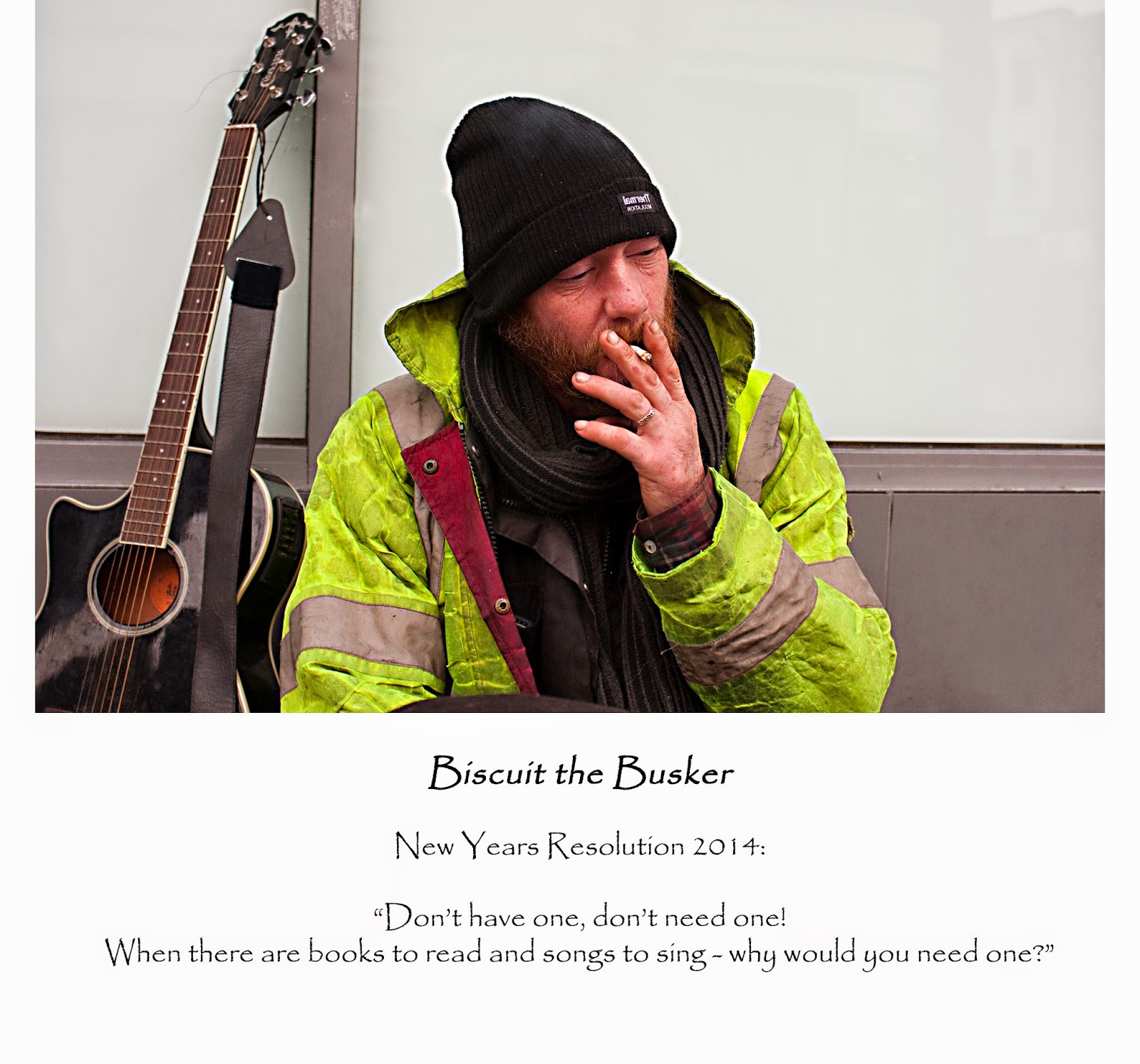
After a chance conversation with a busker, I found my angle - converse with the stall holders to collect their new years resolutions (NYR).

In the first section of this course we have debated 'what makes a document?', the output being: context. As such I have developed a set of images that have two common themes - markets and NYR, thus providing for the viewer a clear context for the portfolio. To add further to the context, I have also titled each of these images with the name (or nickname) of the individual and dated them 2014.


In December 2013 I included this paragraph re: “taking this [project] further”

I intend to continue with this project even though the assignment is completed. If treated correctly, I believe it could be a project that just keeps on going. I am currently debating revisiting the market in July and asking the 'team' how they are getting on with their resolutions. Follow up documentaries are always the most interesting.


Update on Assignment 1 Revisited

Unfortunately, I have been an infrequent visitor to the market since the original project and when I did return to do the catch-up with the team only half of the original people where there. As such it seemed like a  futile exercise, that said, I did not want to give up on what I still believed to be a good project.

Over the next couple of months I toyed with numerous different possibilities around the same theme and during my visit to the Brighton Photo Biennial I finally came to the radical but obvious conclusion – why work very hard with a limited number of people who are resistant to having their photograph taken by you, when you could be working on a much larger scale and engaging with more people by inviting them to join your project by taking their own photograph?

Without doubt, Anthony Luvera’s project entitled “Assembly” influenced my new approach to this project. To summarise the project, Luvera taught a group of homeless people how to take photographs and then 'left them to it’. He then presented this portfolio of images at the Biennial. I referenced his work on my blog in my review on the Biennial.

For my project this time around I did not target buskers or market stall holders; via email I approached family, friends and work colleagues with a very clear and simple brief:

 =================

Subject: Help please - I'm collecting selfies....


Hello,

I am currently working towards a degree in photography and would like to enlist your help for one of my projects.

This time last year I spent countless hours in Nuneaton town centre talking to people (and photographing them) about new year’s resolutions. This year I'd like to extend that project further. So....

The brief should you like to get involved is as follows:
  1. Using your mobile phone (ideally a phone, but any camera will do) take a selfie.
  2. Portrait not landscape please - this helps for when I present the work at Uni.
  3. In terms of the contents of the image it can be anything from a close-up portrait to full body.
  4. Colour or b&w.
  5. With your photo please provide both of the following pieces of information:
    • A new year’s resolution
    • Something from your bucket list
  6. Then please email the photo (jpeg) and your info to me at this email address.

This work needs to be formatted and presented to my tutor pre Christmas so I'd be very grateful if you could send your images to me by the 10th December.

Thanks in advance for your support. Any questions please let me know.

Regards,

  =================

I set myself the target of collecting 50 selfies, so I knew I would not be able to afford to present the portfolio as per the brief ‘8x10 unmounted quality prints’.

In addition, since these images were not taken by me, a key criteria for the assignment was ensuring that the portfolio was visually consistent.

Fortunately, earlier in the year, I watched a video by digiDirect demonstrating the Fujifilm Instax Share SP-1 printer. This printer allows wireless connection and printing of Instax photographs direct from your mobile phone. Whilst this Polaroid-esk format would certainly standardise the photographs, it meant that the information (New Year’s resolution and bucket list item) could no longer be added as captions. One problem solved and another one created.

This problem resolved itself by accident when I dropped some business cards on my desk beside the Instax photographs – they were virtually the same size. The next steps were simple - design a business card format for the information and attach the photograph to the card. The format for presenting the portfolio naturally followed on from there.


Conclusion

The positive response to this project has been amazing, after some initial disbelief people actively wanted to get involved. Not only that, but people actually take the card file away to study the photos and read the information.

A good proportion of the people asked did not have a bucket list at the time, subsequently, they have developed a list and I am aware that a number of bucket list items are currently being actively planned.

The execution of this project, in this format, took significantly less time (probably half the time of the original project) and rather than struggle to ‘get the shot’ people offered me different photographs to choose from.


I commented that the original photographs I submitted for this assignment were “certainly not the best photographs I had ever taken”. I would also have to comment that these photographs are not the best and are undoubtedly not in the same class of the photographs ‘taken’ by Luvera’s homeless people. However, I genuinely believe that these photographs capture the true character of the individuals far more accurately than Luvera’s portraits.


This is what it looks like now.....


Card file
Page view
Page view

Sunday, 9 November 2014

Collaborative documentary

Exercise 49 - visit the the web pages of the "Kingsmead Eyes" project; the original project done in 2009 and the latest "Kingsmead Eyes Speak" project.

Make notes in your learning log about how the work is presented on the website, in particular the use of mixed media - stills, video and audio.

Whilst researching photographers for this topic I came across Gideon Mendel and commented on two of his projects:

1. Through Positive Eyes, Mumbai, India
2. Kingsmead Eyes Speak

I found his work very interesting - his conceptualisation, his execution and his method of subsequent communication.

From my previous post:
Kingsmead Eyes Speak
Another project by Mendel, focuses on the Kingsmead school in Hackney and a group of 28 pupils aged 10 and 11. The children were again taught how to use a camera and sent off to photograph their surroundings - the eyes part of the project. In addition they were required to write a poem as a theme for their images. The images were not made into a video as before, instead the children read their poems aloud and we can hear this - the speak part of the project.
Children are naturally creating and (I believe) have a natural eye for an image and this comes through very strongly with their images. What did surprise me was how very good there were at poetry. I particularly enjoyed Karolina, her images and poetry were excellent; and Mikotaj's poem about his brother being an alien made me laugh.
The 'work' - images and poems - were done by the children, both as a way to communicate their world to the outside world. Whilst both narratives are about the children, they are not linked  - not a visual and verbal  account of the same situation; as such are presented separately. I think adds strength to the body of work because you are given two opportunities to engage with the pupils.

This time around I listened to and read more of the work and I am still impressed by the quality, their vivid imaginations and their sense of humour. 

Sunday, 26 October 2014

Assignment 5 planning (part 4)

Follow on thoughts re what else I could use to focus or rather limit the scope of my project. Having spent last weekend at the Brighton Biennial and been exposed to some fantastic art, I think the scope of my assignment just expanded rather than contracted....

I'm specifically thinking about John Maclean and his project 'Hometowns' - extract from Night Contact programme:
Photographing the hometowns of ones art heroes. If every image we make is the result of an accumulation of other images, should our artistic influences be a source of anxiety, or a source of ecstasy? Hometowns, takes a reflexive view of the subject of artistic influence. It began life as a line in MacLean’s notebook — 'Photograph the hometowns of your heroes’ — an idea for a layered investigation into the places which influenced the artists whose work has coloured his own. Two years later, that line has become a sixty-five-image photo-homage to a unique group of artists who have been mentors-by-proxy, and an endeavour to untangle the strands that connect Maclean to their work.

Hometown of John Gossage
© the artist 
Hometown of Raymond Moore
© the artist 
This leads me to think about 'found art' in the form of archive photographs of my hometown, combined with my own photographs to develop a 'memory of...' series.

Brighton Photo Biennial 2014

Breakfast on Saturday morning at the Lucky Beach
Great weekend in terms of meeting people - students and tutors, discussing OCA work and getting a general overview of what's going on in the art world. I highly recommend this to all students and hopefully I'll be lucky enough to be back in 2 years time.

Rather than comment on all of the exhibitions we visited I'm going to limit this post to the items that spoke to me.

'Afterimage' by Cornford and Cross
"This was series of works produced from the removal and destruction of their photographs, which were previously conservation mounted onto aluminium substrates." (Taken from the gallery write up.) After much discussion in 'my' immediate group, it was decided this this was not photography, in fact we decided to call it not-photography. Nonetheless we all agreed that is was interesting conceptual art.

Reflection of the OCA group in one of the Aluminium substrates

'36 views + Sub-Urbia' by Adrian Turner
"In the summer of 2002, I stopped driving the 1.3 miles to work and instead started walking and taking photographs along the way." (Taken from the gallery write up.) AT selected a number of his photographs and printed them A5 on quality card for visitors to take away - a nice touch. I will always have fond memories of 'Manor Hill'.

Manor Hill by Adrian Turner

Another interesting discussion about landscape and about tutor feedback re landscape submissions. One of these landscapes was what we considered to be 'classically' romantic, drawn directly from the style of the old masters - a soft-focus view through trees towards distant buildings. This lead us to discuss the influence (or not) of painting on contemporary photographic practices; this further lead to a discussion re what was acceptable to include in a photograph as an urban landscape - for example, is it ok to leave litter, telegraph poles and wires or gutters in your image? Do these items add to the overall aesthetics of the image? The general view was that whilst it may not be a 'pretty' aesthetic, it was still fundamental to the overall feel of the image and therefore an important part of the overall aesthetics.

I found it interesting the number of students that commented (afterwards) as to similar feedback that had received about 'sanitising' their work re the un-pretty aesthetics of everyday life. 

'City Gorged with Dreams' by Currie and Gates
"All the images have been shot in and around Brighton over the past year, and are an attempt to glimpse a side of the city that is often overlooked or ignored." (Taken from the gallery write up.)

In my opinion this is psychogeography in its purest form and this particular exhibition contains some very well seen and composed images.

'Assembly' by Anthony Luvera
Allegedly these images were taken by the individual in the image - might as well start on a controversial note... The photographer taught this group of homeless people how to take photographs and then 'left them to it'???? It is remarkable as to the similarity of the final images. I stress at this point that the images are excellent, impactful and even compelling, I just don't accept that they were taken by the homeless individuals. Naturally our discussions centred around what it meant to actually 'take' a photograph, does Crewdson actually press the shutter - no, but does anybody dispute he's the photographer - no! In this particular case, I feel the situation may have been reversed; the shots were set up (composed, choreographed) by the photographer, but the actual shutter was pressed by the individual - possibly as part of the engagement in the project. This lead us down the murky road towards authorship - hay, ho...

This exhibition was unfortunately rather overtaken by the Photo Publishers Market and limited the amount of time  we spent there. I did manage to pick up a little book of old photographs taken of my home town - I think this will be an excellent springboard for a personal project.

'Re-mapping the flaneur' by Wideyed Photography Collective
The feedback regarding this exhibition was very mixed - I liked it, the concept and the format of the presentation.

Inspired by Walter Benjamin’s Arcades Project and the advent of cloud printing, it is the result of a collaboration between 97 photographers from 20 collectives based in 15 countries, and was designed to provide an overview of the global collective movement, of contemporary photographic practices, and the complexity of urban life worldwide.
Unrolled scrolls creating a wave

Basically there were lots of small images printed/exposed at various intervals along very long scrolls of paper. The images were of nothing special - just everyday life, the sort of thing you take on your phone to show your friends then delete; photographic white noise. In the first room the scrolls were threaded over pipes to create a waveform, then in the second room there were pinned to the wall - this gave the impression of walking through a life that was time-stamped by images. At the end of the scrolls, there were a little set of wooden draws that held all of the images - even the ones you couldn't see because they were hidden in the rolled up paper.

The Photography of Extremes in 1970's Italy
This collection of images attempts to communicate the challenge faced by the press photographers of the day bounced between snapping celebrity images and covering the civil war. 

Photographs, videos and film presented in the old wooden bookcases

Curated by Roger Hargreaves and Federica Chiocchetti, the presentation forces the visitor to engage with the exhibition - sometimes by stepping back in order to be able to see images presented on the upper shelves of old wooden bookcases, and sometimes by leaning in or bending down to look closely at images lying in the floor. Interestingly we are required to step back from 'riot' images - a natural reaction for most people, why would you want to be close to or involved in a riot? Conversely we are required to step forward to look over dead bodies, an uncomfortable situation especially as some of these images are very graphic.

'Silent Fore to Aft' by Tom Pope and Terrence Smith
This was a collaboration in that the two decided to cycle on a tandem from London to Brighton and make a film about their trip - the constraint the gave themselves was not to speak to each other for the full 7 day journey!

The film (15 minutes) was an absolute hoot. The film began relatively normally, recording the journey, the scenery, etc; but as they got into the journey it became more and more bizarre with their exploits, at times, becoming pure slapstick comedy. At one point in the film, (about 3 days into the journey) you can feel the tension building as they realise the enormity of the task they've agreed to take on.

We were fortunate to have them present their journey and explain the rationale behind the collaboration. It is a mad film and an equally mad task, but it was very interesting hearing them talking about how seriously they took the 'mission'. Well worth seeing the film if you can, but before you watch it think about how you would cope spending 7 days with the same person and not talking to them!


Overall a fantastic weekend - I highly recommend it!